
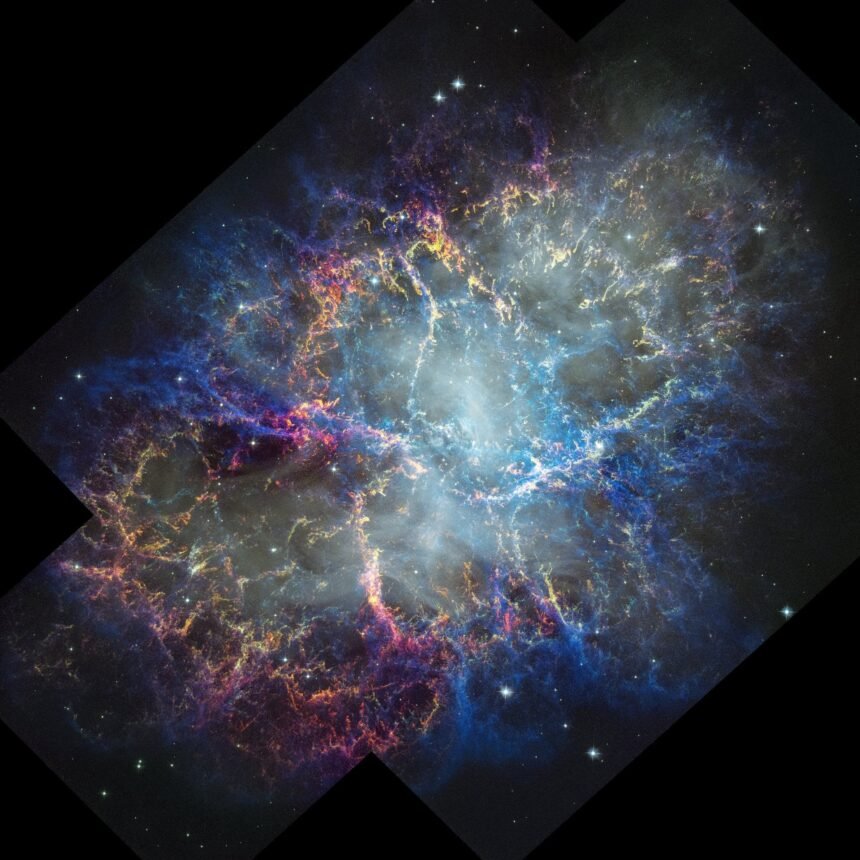
A Celestial Wonder: The Crab Nebula’s Expansion
In the year 1054, a sudden and mysterious ‘guest star’ appeared in the night sky, captivating the attention of ancient astronomers from various civilizations worldwide, including Chinese astronomers who meticulously recorded this phenomenon. This fleeting yet spectacular event lasted for several months, only to disappear into the vast expanse of space. Little did these early stargazers know, they were witnessing the birth of the Crab Nebula, a remnant of a massive supernova explosion.
Centuries later, with the advent of modern astronomy, the Hubble Space Telescope has been observing the Crab Nebula for over 25 years, providing invaluable insights into its expansion and evolution. This prolonged observation has allowed scientists to study the nebula’s dynamic changes, from the movement of its intricate filaments to the pulsar at its heart, which is a rapidly rotating neutron star.
Key Observations and Discoveries
- The Hubble Space Telescope’s high-resolution images have revealed the Crab Nebula’s complex and ever-changing structure, with filaments of gas and dust expanding outward at tremendous speeds.
- Scientists have been able to monitor the energy output of the pulsar, which powers the nebula’s glow, offering clues about the physics of these extreme objects.
- By analyzing the light emitted by the nebula, researchers can infer the composition and temperature of the gas, shedding light on the supernova’s chemistry and the formation of heavy elements.
The study of the Crab Nebula is not only a window into the past, offering insights into the supernova that gave it birth, but also a laboratory for understanding the physics of extreme environments. As the Hubble Space Telescope continues to observe this celestial wonder, scientists anticipate making further discoveries that will deepen our understanding of the universe and its many mysteries.